


A pumice stone and a foot file rely on you to supply the pressure, the angle, and the consistency. A clinical grade electric polisher supplies all three itself which is precisely why the results don't compare.
Ask a podiatrist what's wrong with the average foot file sitting in a bathroom cabinet, and the answer isn't the tool itself it's the person holding it. Manual filing depends entirely on human input: how hard you press, how evenly you move, how long you keep going before your arm gets tired. Every one of those variables changes the result, and none of them are things a hand can reliably control session after session.
Electric filing removes the guesswork. A motorised device supplies constant, even rotation regardless of grip strength or patience the same principle podiatrists rely on in clinic, now built into a device designed for the bathroom shelf. That's the entire premise behind the SynxPedi 3-in-1 Electric Foot Polisher, and it's why podiatrists are recommending it in place of manual files, pumice stones, and foot graters.
The Manual Filing Ceiling
A standard foot file or pumice stone works on abrasion you drag a rough surface across skin and hope the friction removes enough dead tissue without taking too much. The problem is that manual pressure isn't measurable. Press too lightly and thickened callus barely shifts, session after session. Press too hard, particularly on already-thin skin around the heel edge, and you risk irritation or breaking the skin, something podiatrists see often enough in clinic to flag as a genuine risk of manual over filing.
There's also the consistency problem. A pumice stone wears down unevenly and can't be adjusted for a stubborn patch of callus versus a more delicate area nearby it's one texture, one intensity, for the whole foot. And because manual filing tires the hand quickly, most people stop well before the job is actually finished, which is why the same rough patches tend to reappear within days.
Rotation Does What Friction Can't
An electric device changes the mechanics entirely. Instead of you supplying the movement, the motor does at a constant, repeatable speed that doesn't fade as you go. The SynxPedi 3-in-1 Electric Foot Polisher uses dual rotation technology, meaning the head spins bi-directionally rather than in a single repetitive motion. That mimics the back-and-forth technique used in professional pedicure treatments, delivering a smoother result with less vibration and less heat build-up than single-direction devices.
Because the motor not your hand is doing the work, you can hold the device steady and let the attachment do the filing, which is a big part of why podiatrists consider electric tools more predictable than manual ones. Six variable speed settings mean the same device can be dialled right down for sensitive skin or turned up for genuinely thick, hardened callus, something no pumice stone or handheld file can offer.
"The best at-home tool doesn't just remove skin it removes it with the same control a podiatrist would use in clinic."
One Device, Three Jobs
Most bathroom cabinets end up with a small collection of separate tools a pumice stone for callus, an emery board for nails, maybe a foot file for cracked heels. The SynxPedi 3-in-1 Electric Foot Polisher was designed to replace that entire collection with three swappable attachments on a single cordless handle.
- Sanding Head: For hard skin and callus, used with 10 replaceable sanding discs for hygienic, single-use application.
- Nano Glass Head: For fine polishing once callus is reduced a gentler finish than any manual pumice.
- Nail Sanding Head: For thickened nails or shellac removal, with 5 replaceable sanding rings.
- Ergonomic Handle: Whisper-quiet, cordless, and shaped to sit naturally in the hand for longer, steadier sessions.
Swapping between attachments takes seconds, which means the whole foot care routine callus reduction, polishing, and nail care happens with one device instead of three, and with the same motor-driven consistency throughout.

Manual vs. Electric, Side by Side
| Factor | Manual File / Pumice |
Synxpedi 3-in-1 Electric Polisher |
| Pressure control | Entirely dependent on hand strength and fatigue |
Motor driven, consistent from first minute to last |
| Precision | One texture, one intensity for the whole foot |
Six speed settings, three purpose built attachments |
| Coverage | Callus only separate tools needed for nails and polish |
Callus, polish, and thickened nails from one device |
| Hygiene | Same abrasive surface reused indefinitely |
Disposable sanding discs and rings for each session |
| Consistency over time | Uneven wear, inconsistent results session to session |
Repeatable rotation delivers the same result every time |
Why Disposable Sanding Discs Matter for Hygiene
One detail that's easy to overlook: a pumice stone or foot file is reused indefinitely, holding onto dead skin cells and moisture between uses regardless of how well it's rinsed. A 3-in-1 electric foot polisher's sanding discs and nail rings are designed to be replaced after each use a small change that keeps the routine genuinely hygienic rather than just abrasive.
Refill packs keep the routine going without needing a new device a fresh sanding disc for callus work, a nail sanding ring for thickened nails, and the nano glass head for finishing, all available separately as attachment refills.
Podiatrist-Recommended Electric Foot File Routine For Salon Smooth Results
Step 1 - Reduce. Use the Sanding Head with a fresh disc on hard skin or callus, working at a lower speed setting until skin is smooth, increasing intensity only where callus is genuinely thick.
Step 2 - Refine. Follow with the Nano Glass Head to polish and smooth the finish a step manual pumice stones can't replicate.
Step 3 - Maintain. Use the Nail Sanding Head on thickened nails or to prepare nails before polish, replacing the sanding ring each session.
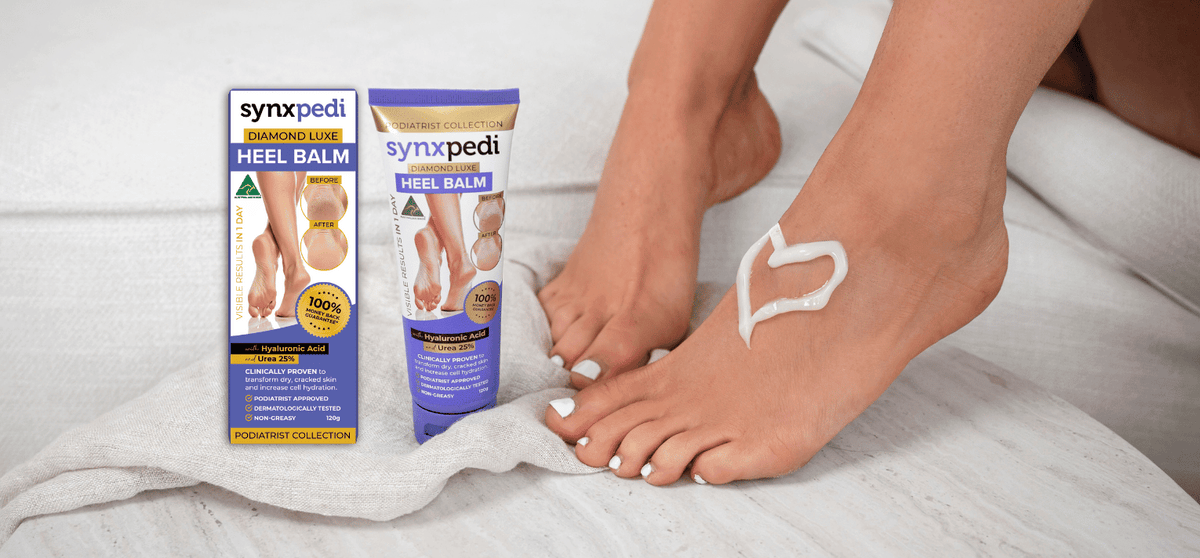
Step 4 - Lock it in. Finish with SynxPedi Diamond Luxe Heel Balm 25% urea with hyaluronic acid and pentavitin to hydrate freshly smoothed skin, repeating the full routine roughly every 2–3 weeks depending on how quickly callus rebuilds.
Electric Foot File FAQs
1. Is an electric foot file better than a manual pumice stone? - Yes, for consistency. A manual pumice stone depends entirely on hand pressure and technique, which vary from session to session. An electric foot file supplies constant, motor-driven rotation, giving a more even and repeatable result on calluses and hard skin.
2. Can an electric foot file damage your skin? - Used correctly, an electric foot file is generally gentler than manual over-filing because it removes the guesswork of hand pressure. Start on a lower speed setting, avoid broken skin or active infections, and stop if you notice heat, irritation or pain.
3. How often should you use an electric foot polisher? - For established callus, every 2–3 weeks is typical, depending on how quickly hard skin rebuilds. Lighter maintenance sessions with a nano glass or polishing attachment can be used more frequently.
4. What's the difference between a foot file and a callus remover? - A foot file is a manual abrasive tool. An electric callus remover, like a 3-in-1 electric foot polisher, uses a motor to rotate an abrasive head at a consistent speed, and typically includes interchangeable attachments for callus, polishing and nail care in one device.
5. Are electric foot files safe for cracked heels? - Electric foot files can help reduce the built-up hard skin that contributes to cracked heels, used on a lower speed setting. They shouldn't be used on open cracks or broken skin pair with a urea-based heel balm such as SynxPedi Diamond Luxe Heel Balm for the hydration side of treatment.
Electric filing isn't a gadget upgrade for its own sake it's the same rotational, motor-driven principle podiatrists use in clinic, scaled down into a cordless device for home use. If manual files and pumice stones have left you re-doing the same patches of callus every week with little to show for it, this is why: the tool was never the limiting factor. The consistency was.




Share:
Why Your Feet Feel Heavier and Sorer In Winter
Gel vs Fabric Toe Sleeves: Which One Solves Your Toe Pain?